Showing posts with label Philosophy. Show all posts

Sunday, October 29, 2006

Song of Life

Dearest forever, I’d give my life away,
I’d ask you never, for e’en one little day,
Yours just to do with as you pleased,
Yours til the life in it has ceased,
For I trust you in everything you do.
My strength—I’d give you all I have,
My heart for only you would beat,
And all my prayers be your retreat,
For all my love then to atone,
For I trust you in everything I do.
(Early 1920s)

This undated poem was typed with a stanza format, internal and line- ending rhyming, plus two conventional poetic word usages, (“e’en” for even, “til” for until), that makes me think mom wrote it while she was a student studying poetry (or music, since she called it “Song of Life”). Its theme is the classic “Bride of Christ” theme, expressing the total commitment and trust and devotion to Christ, to be and live as He, the Son of God, would want her to be and live. This attitude reflects her devout Irish Catholicism. Regardless of when she composed it, she never wavered from this attitude of devotion, but seemed rather to grow stronger in it as the trial and tribultaions wore on. For mom, spiritualty infused and surrounded everything we did. It emanated from nature itself. It seemed to me, as a child growing up under her wings, that it was in the natural order of things that mom found reinforcement for her faith. Her attention to the events of nature--the sun rising and setting, the seasons coming and going, plants springing up each spring, the phases of the moon each month--these were all aspects of God's power and love for man. Our task was to respect and trust in His power and love and to return these through our everday actions. She offered everything up to God, living out as well as anyone I've every known the words of Saint Benedict, "To work is to pray." Her very life was a song of praise written for the glory and honor of God. All who met and knew her seemed to sense this humble yet powerful and radiant nature of her personality.

Saturday, October 28, 2006

Be Strong

We are not here to play, to dream, to drift.
We have hard work to do and loads to lift.
Shun not the struggle.
Face it. ‘Tis God’s gift.
(Early 1920s)


Mom scrawled this on the inside of the back flap of her composition notebook from Loretta Heights College in Denver, where she was studying to be a nurse. Eventually, she left her studies to return home to the farm in Heron Lake to help her family, becoming a teacher in a local school. The little poem captures her philosophy of working hard, not complaining, seeing every struggle as an opportunity given by God, bestowed on us by Him, to carry out His will. All her life, through every household move, every child pushing inexorably toward his or her own independence and suffering inevitable setbacks and disappointments, she never wavered from this attitude.

Once when I was trying to tuck her into bed a couple of years before she died (about 70 years after this poem was written!), I was trying to get her into the middle of the bed so she would be more comfortable and not roll off. She was kind of stiff-bodied then and hard to move. It was a struggle. I got her head on the pillow but, lying on her side on the edge of the bed, she looked like she was uncomfortable and might easily role off. I was worried and asked, “Are you comfortable, Mom?” She answered, with that Irish chuckle of hers, ”I didn’t know that was the goal.”

That was a profound moment of insight for me and an object lesson in life. In an instant I got the point: embrace what is, accept it and go on…in this case, discomfort and to sleep. “Face it.” Of course, I was at that time in the middle of having to face horrific personal struggles of my own, but the lesson was there, right before my eyes. Mom was strong, stoic, accepting, uncomplaining, never shunning the struggles given to her. There it all was, lying like a lump under the covers, a spent and wracked 92 year old body, long past trying to be comfortable, just happy now to have a warm place to rest her head, and a son to tuck her in. “Good night, Mom,” I said. “I love you.” “Good night,” she said, her voice barely audible. “I love you, too.”

I walked out of her room that night, shutting the door behind me, tears welling up inside, thinking how lucky I was to be around a mother so strong, so loving, so accepting, so much at peace with herself. I was 50 years old then and living with her in the Fedora Street house in Fresno. Within a year or so I had to face the decision, with the help of the family, to put her into a 24-hour care residential facility. That was, ultimately, one of the five or six most difficult struggles of my life. I searched around for months. Found one close by, but it was eventually unacceptable to us. We looked so more, lways struggling against ourselves, until we finally got an interview with the highly regarded Armenian home. She had to interview for this “position,” not being Armenian and not having any money or inside connection. Once I realized she was going to be interviewed, I knew inside that we were in luck: How could anyone not want to take care of her once they meet her? I thought. I was right with this feeling. They accepted her on the spot!

“Be strong.” Good advice, but to feel it deep down in your bones, all the way to your toes, that takes years and years of practice. She had it…the strength…and I was still just learning about it.

Wednesday, October 25, 2006

My Dream House

It isn’t, of course, and it shan’t be,
For years and years where passing eyes might see.
Yet deep in the depths of will be, must be,
Already it stands complete—
Pine trees hiding the drive,
Sheltering the doorway and nooks,
Rugs on the floor—dishes, pictures and books,
A wide fireplace and a winding stair for looks.
Surely you’ll love it, this Dream House of mine,
And visit it often any season or time,
When drowsy south winds hum prairie tunes,
Or biting north gales tempt fireside runes.
In summer a door open wide—
In winter a lantern outside!
My Dream House, come true!
(1920s)


Technically, this is one of mom’s most complete and perfected poems, I think, each word working well to flow with the next, sketching out the colorful, concrete details of the dream, each line building the theme. The poem was typed with only four small corrections and three phrases added in pencil, which suggests that she had worked on it by hand several times before finally typing it, and then made a couple of changes. This was probably written while she was in college or just afterward, in the early 1920s. It shows her romantic nature and deep sense of home and hearth, of having a warm place where others are welcome, a place with mature “pine trees” hanging over the driveway and the house, with “pictures and books” and a “wide fireplace.”

Mom kept this dream alive throughout her life. She seemed to literally will it onto each home or apartment we moved into—and there were dozens! Each house or apartment was to her, “not just a house, but a home,” (her words, always!) and she made certain that we hung family pictures and set out the books in the bookcases. She was always looking forward to anyone who came to visit. She wanted to share, not just her physical space, but her entire dream of place, the feeling of being “at home.” The phrase “fireside runes” is significant. “Runes” is an old word and it means poems, verses or songs. Only a student of poetry or a literate person would know this word and be capable using it appropriately, as she does here. It conjures up images of people coming in out of the cold, warming up next the fireplace, and sharing stories of the day—maybe as mom remembered her father and brothers doing during the cold winter months on the farm in Minnesota. Since her grandfather was an Irish barroom balladeer, the singing of Irish runes had to be part of the family mindset. Symbolically, she re-enacted this scene every time a visitor came to the house—preparing warm tea or coffee, cookies or cake, and sitting at the coffee table, visiting, attending, listening—and, if we had one and it was winter, near the fireplace with the logs burning! Overall, the poem captures mom’s eternal optimism and hope and the intricate detail of her imaginary world.

The final line is a poignant and sad one for me. In 1989 when I visited mom in her first convalescent home (St. Francis Home) in Orange county, I knew I had to do something to get her out of there and into a real home again. Though it was a nice Catholic home with a large garden and the nuns were friendly, mom had to shuffle her way down the long corridor to the chapel (Bob had done his best to get her into this home). Her feet hurt her immensely by then. When I saw that she had to sleep in a narrow room with a bed four feet from a stranger and her feet hurt her every time she went to eat or to visit the garden, I set out to buy a home through the VA in Fresno. I brought her up within a month or two to live in an apartment wiwth me until we could move into the home.

The home on Fedora Avenue was my final effort to get mom into, if not her Dream Home, a comfortable home for her last years. The move worked, I think, for she loved the grape vines and the pomegranate tree and all the shrubs. We planted pines in the front that did hide the front doorway and the small porch. She’d sit there among the geraniums and watch the neighborhood kids pass by on their way to and from school. All the family came over to help to make the place comfortable for her. Don built a long ramp so she could get out into the back yard easily. Jerry and Bob put some special hand bars in her bathroom, and the girls all helped to get her room and the kitchen organized so it looked homey. And the bookcases—we had several in each room, a large window looking out into the gardenesque back yard where one summer we tried growing corn and peas and beans and carrots and strawberries. The “we” was always me by then, though, for mom was too unsteady to do any gardening. The dog I got from the pound ate the corn (Bob called him Corn Dog!) and most of the vegetables didn’t produce much, though each day we’d check to see how they were doing. Mom put her statue of St Francis in the corner under a tree so she could see it from her window.

We only lived there a few years, mom and I and Cory and Devon, when they came over, but it was “home,” her last in her fading years and one that left her with good memories. When we finally moved her to the very nice Armenian Home in the countryside of east Fresno, she had a spacious room with a bed by a large window. Outside was a lemon grove. There the “bird with the red eyes,” which she said had followed her from the Fedora home, perched on the branches everyday and looked in on her. That was the same bird she saw flying high overhead the afternoon before he died. She stayed in the Armenian Home for about a year before passing away February 24, 1996. The staff there loved her and respected her as very unique and uncomplaining. They missed her when she finally passed away. Though it wasn’t exactly her Dream House, the Armenian Home was ranked as one of the best rest homes in the state and, in the end, it did get her back into the country, which she very much appreciated.

Sunday, October 22, 2006

Builders


To help someone?
Is that our aim in life?
To help another find his peace

and brave his daily strive?
To find the kinks which others make,
And smooth the paths which they must take,
And just help along with a singing song—
Could that my mission be?
Perhaps ‘tis so…
To walk beside a Builder,
yet not the Builder be.
Tis thus, then I shall gladly go.
(1927)

Mom wrote this in her college composition book at Loretta Heights. It shows the young adult’s searching for clues to there own identity and direction. Here she weighs the purpose of her life as being that of a helper, perhaps even help by cheering up “with a singing song.” I’m guessing the word” Builder,” since it is capitalized, refers to God, the Creator and Maker, and her wish is to “walk beside” him in her journey through life. As Leretta Heights College is in Denver, I'm sure she sought inspiration and guidance about her future through the natural beauties surrounding her in the mountains of Colorado, as well as through prayer and her trust in the "Builder" of all things, including mountain streams, waterfalls and our own pathway to the future.

Saturday, October 21, 2006

Friendship


Oh, Friendship is a funny thing!
You never know “for sure.”
It keeps you always wondering!
This doubting, fearing, hoping

and worring to endure.
But still, my friends, I’ll never give up,
Though sleep awake I must.
I’ll listen til the wonderings stop,
Or till they turn to dust.
Pensive One
(1927)

This was written in November 1927 in mom’s college composition book while she was at Loretta Heights in Colorado. She signed it “Pensive One.” It reveals her understanding of the mixed feelings we often have about our friends and ourselves in friendship, our doubts and fears and anxious, sleepless nights. I can imagine she was struggling with meeting new people, students from around the country, for the first time, and like many college students struggling to determine how to establish intimacy and trust with people she was meeting in college. I like the last two lines, “I’ll listen till the wonderings stop, Or till they turn to dust.” This reveals her deep commitment to stay with others until she is satisfied she understands them or can no longer go any further with them. It is her sense of determination applied here to interpersonal relationships and gives a glimpse into her core value of long-term commitment to others.

Sunday, October 08, 2006

The Value of Time


The value of time.
The success of perseverance.
The pleasure of working.
The dignity of simplicity.
The worth of character.
The power of kindness.
The virtue of patience.
The wisdom of economy.
The obligation of duty.
The influence of example.
The improvement of talent.
The joy of originating.
(1940s)

This is an amazing expression of art and philosophy. It was written on a small jagged piece of cardboard, above, that looks like the corner of a laundry detergent box, in ink, and looks like it was written hastily. The parallel syntactical structure, the repetition of “the” and “of,” interlocked with 24 separate words that spell out mom’s ideals or principles for living, truly create a mini-masterpiece. I can imagine her having this inspiration while doing her chores, maybe just emptying out the soap box and tearing off the corner, and then sitting down for a moment (only a moment, for she never wrote long epic or two page poems!) and jotting down these lines, then tucking them away somewhere later that evening. I know that is how she went through her day, working and thinking and “originating” all day long and, lucky for us, putting some of herself down on scraps of paper or cardboard for us to have sometime way down the line. Important, too, is the fact that there are twelve principles here, twelve very positive statements about how to view life. I don’t think this is accidental. Twelve is a significant number and mom was very conscious of its many associations: moons, months, apostles, hours in a day, children in her own family, etc. She thought in these patterned yet multi-layered ways. The multi-leveled symmetry here is remarkable and, I’m sure, deliberate.

Saturday, October 07, 2006

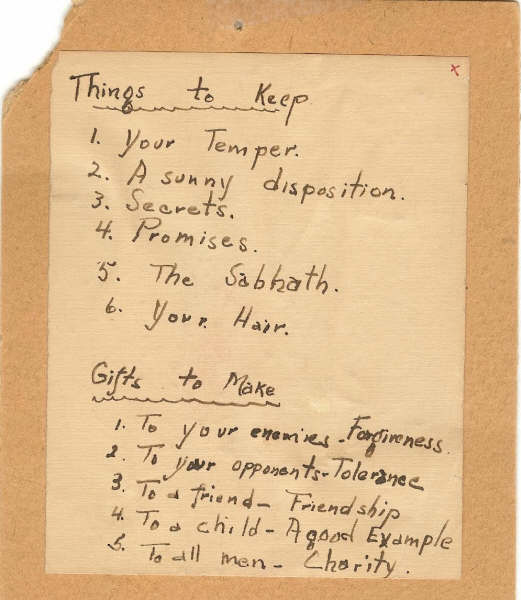
Things to Keep, Gifts to Make


Things to Keep
1. Your temper
2. A sunny disposition
3. Secrets
4. Promises
5. The Sabbath
6. Your hair


Gifts to Make
1. To your enemies: Forgiveness
2. To your opponents: Tolerance
3. To a friend: Friendship
4. To a child: A good example
5. To all men: Charity
(1940s)


This was neatly written in ink on a small paper and glued to a piece of cardboard, shown above, which makes me think it was special enough to preserve and keep handy as a reminder for mom to stay on track. If so, this writing shows mom’s commitment to self-improvement and growth, a commitment that I witnessed throughout her life. She was always interested in keeping up with new developments in the sciences, etc, and loved learning through books and the newspaper (always clipping out articles) and TV shows like travel shows and National Geographic.

Equally important here, though, is the clear sense of moral and social values that mom had. She exemplified each of these, taught them to us both implicitly and explicitly all her life. That she wrote this (as opposed to copied it from somewhere) is suggested by item #6: “Keep you hair.” This was mom’s trademark. It symbolized her utter sense of discipline. She always “freshened up” before dad came home for dinner, and, until she was well into her 70’s, braided her own hair and kept it neat. I don’t know exactly when she first stopped this and began going to a hair salon, but that head full of long black neatly braided hair was a constant for us. It was more than a fashion statement: it was her philosophy—clear, straightforward, simple, neat, direct, unpretentious.

She literally lived this code of life, these eleven principles, and did her best to pass it on to us. There was really no mystery to mom, no misunderstanding her, no ambiguities, no double messages, no inconsistencies. She was totally congruent, was on the outside what she was on the inside. It is this level of wholeness and integrity that made it hard for all of us to emulate and perhaps, when we chose our own mates later in life, in some way, hard to really know and accept them for who they were, unconsciously measuring them against our own idealized parents, especially mom, in this case. Just a thought, though one with psychological support: It is difficult for sons to differentiate from such powerful mother figures and for daughters to find in men the qualities they see in their own idealized fathers.

Friday, October 06, 2006

Today Belongs to the Future

We give it all.
We never know what time will grow.
Today we sow,
Tomorrow reap—
A little seed cast here and there,
And tended with our loving care.
No one plants all he can keep.
(1940s)

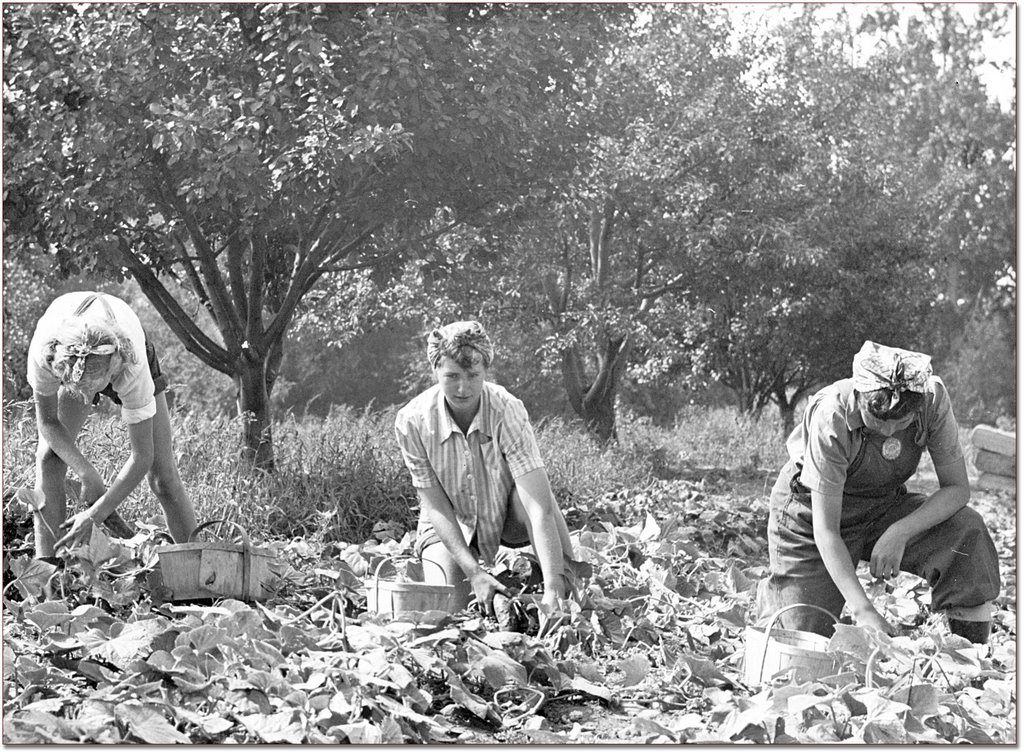
This was scratched out in pencil on the back of a White Plains Corn Flakes Shopping items note sheet, probably in the 1940s. A few words have been changed and a line torn off at the bottom. Probably a thought mom had as she was working in the kitchen. Her connection to the soil, her farming background, and her scriptural mindset are all presented here in a statement that reflects her philosophy that we do things today in preparation for tomorrow. Mom always looked forward to the spring, even when we lived in small apartments and could only plant flowers in little pots or flower boxes on the patio or next to our door. All she needed was a sliver a space where the sun shined. She made that her garden, even if we just had a few pansies.

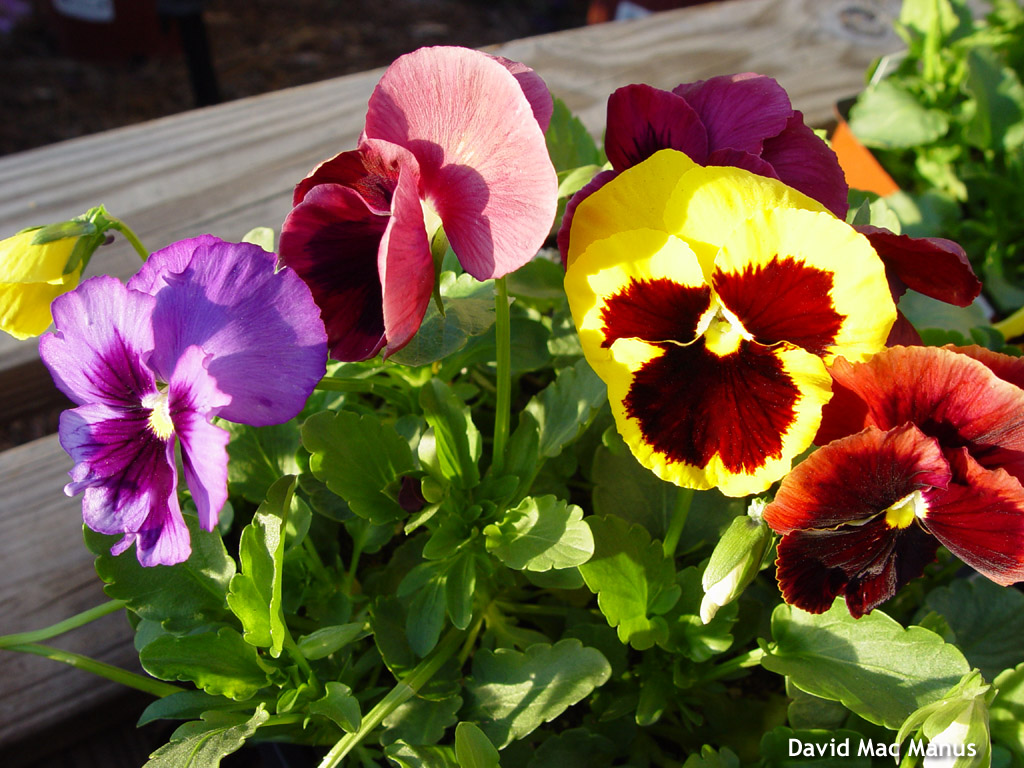
Each spring we had to plant something. That was in her fiber from her days growing up on the farm. Once (1991?), when we were living in the Villa Apartments in Clovis, I planted a few pansies across the sidewalk outside our kitchen window. She enjoyed watching them every morning while she had coffee and toast. Just two or three purple and yellow flowers, maybe, 10’ square at most. I imagine, symbolically, she saw in them a whole field blooming, watched the sun bring out their colors, the breeze move their pettles. These gave her a focal point, a familiar grounding and center. Of course, the true flowers were her children, and through them her grandchildren, which she attended to and “tended,” each one as she could, with “loving care.” Giving completely of herself, whether parenting or gardening, was her trademark. She knew what she was doing was for the future, not just her selfish gratification. And she knew that it is the nature of both growing flowers and raising children that we must let go: “No one plants all he can keep.”