Showing posts with label FAMILY. Show all posts

Saturday, October 14, 2006

Life Everywhere

Mother Dear—
And it’s spring again,
New life budding everywhere—
In the treetops, and the bushes at the curb,
Down the street—
A peony sprouting under the ivy,
And a rose peeping up through our pansy bed,
And a downy-white cherry tree glorifying
The “Guest Room,”
Awaiting that precious life to bloom when the cherries ripen—
There’s awakening this spring,
Both inside and out!

(May 1931)

This poem was clearly written in Beverly, MA, while mom was pregnant with Mary, who was born just two months later on July 1, 1931. This is truly a beautiful expression of mom’s devotion to Mary, the mother of Jesus (“Mother Dear”), after whom she named her first child, and of her deep sense of being a part of nature, of the creative process. She and the trees and flowers around her are one! This poem brings the essence of her personality together better than any other of her poems, I think. In 65 words, she has interwoven the major themes of her life: love of God, Love of Mary, love of family, love of nature, love of home, and love of her role as mother and as homemaker. This is the beauty of the poetic mind—to condense so much meaning into so few words.

I can only imagine how excited she must have been, how respectful she was of this gift awakening inside of her, her first child, paralleling the awakening of the life outside—the trees, peonies, roses, cherry blossoms, even the ivy and the “bushes at the curb!” She was so connected to the life around her, so much a part of it, so aware of the details around her. And the idea that she called the baby’s room, which she and dad must have gotten all ready for Mary, the “Guest Room,” conveys her deep sense of being honored to be a caretaker, a host, not to her own children, but to God’s children given to her to love and to nurture along until they too, like the trees and flowers outside her window, can stand on their own as part of God glorious creation.

Thursday, October 12, 2006

Between Two Fronts

Abroad awaits the cry:
“The Second Front is opening—Stand by!”
At home, already two fronts we stand between—
The front of today and the front of tomorrow.
Our perspective must be clear-cut and keen.
When the detonation of Pearl Harbor blasted millions of ears
And closed the senseless front of yesterday,
Like empty urns along the curb we passed them by,
Those beautiful babies of yesterday.
Battered and smudgy and hardy they grew,
Like empty urns now they gathered rust
With every wind that blew—Protection they never knew
Push or be pushed—survival now—
Instinctive nature’s cry.
It’s God’s world and no man lives for himself alone.
God’s spirit must survive.
We’re duty-bound to serve our Father’s will.
The curtain rises on the Lost God of this Tragedy of the Age.

1941

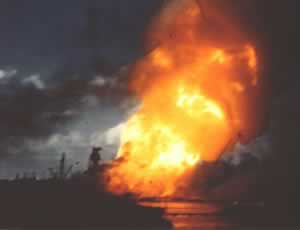
What strikes me most about this statement is its deep anger and sense of senseless tragedy. It is a fragmented grouping of ideas, probably written just after the bombing of Pearl Harbor, December 7, 1941. There is no attempt to revise or re-order it. I imagine mom wrote it down to express her strong opposition to war as a way of dealing with conflict, seeing it as a clear violation of acting in accordance with God’s plan. Everything was measured against the backdrop of her religious faith. I’m sure she knew, too, the U.S.’s long-standing official policy of trying to stay out of the war, though that policy was becoming increasingly untenable as Japan continued its march across Asia and "a second front was opening."

Ironically, this poem has some inner chaos in it, reflecting the chaos on the ground and ships during the bombing of Pearl Harbor. Technically, I don’t think mom meant it to come out that way. However, this bit of fragmented thought must reflect her fragmented feelings at the time, being so close to the Navy personnel through the USO at Newport Naval Station. That had to be a shocking time for everyone, especially there in Newport which was so dominated by Navy families. Dad, too, as Director of the USO, had to be very worried, for he was close to so many of the officers and sailors stationed at the base. The “battered babies of yesterday” were the 2,300 soldiers, sailors and civilians killed at Pearl Harbor, as well as the tens of thousands of soldiers and civilians that had already been killed in the war up to that point. Also, I imagine she had in the back of her mind the thought of her own five sons: that someday they, too, might have to go to war. She had lived through WWI and knew the costs in human lives: 37 million casualties, military and civilian (15 million dead, 22 million wounded) and was now seeing America enter another major conflagration. Her phrase, “This Tragedy of the Age” echoes President Roosevelt’s words about Pearl Harbor: “This is a day that will live in infamy!”
Before it was over after the dropping of the bombs on Hiroshima and Nagasaki, WW II would prove the deadliest war in history: 66 million deaths worlwide, including 37 million civilians and 22 million military. One can almost hear her sense of these numbers, which she couldn't have known yet at the time of Pearl Harbor, the shocking senselessness of them, in her final line: "The curtain rises on the Lost God of this Tragedy of the Age!" When I think of the "less deadly" (to dare to use such a phrase) conflicts that followed (Korea, 54,000 dead, 103,00 wounded; Vietnam, 58,800 dead, 128,00 wounded; and now Iraq, 2,842 dead, 21,077 wounded, all U.S. military personnel only, not counting the millions of other military and civilian casualties), I can only imagine the horror mom (and all mothers) must have felt, knowing the nation was about to crank up its military operations and send over a million of its sons and daughters into combat. Over 350,000 women served in the military during WW II.

I was born a year after Pearl Harbor, but I do remember hearing mom express her opposition to war as a mean to resolve international conflicts during the Korean war, when my oldest brother Mike entered the army, and throughout the Vietnam War, especially when I went off to boot camp in 1966. I remembered from my studies in English literature a statement of the British writer, G. K. Chesterton, that seemed to echo mom's sentiments about speaking out against war even as we are waging it and going forth to fight in it: "A man who says that no patriot should attack the war until it is over...is saying no good son should warn his mother of a cliff until she has fallen." I knew her to be a solid patriot as well as a thoughtful person. Afterall, one of her heroes was Eleanor Roosevelt! She knew of the cliffs that lay ahead, for both her and her sons and daughters. As I left home for boot camp, not knowing whether or not I'd be sent to combat in Vietnam, I saw a tear in my mom's eye as well and a look of sheer strength and resignation, a smile even, of pride, hope and encouragment. It was this look, this look of strength and faith in the face of the unknown, that I carried with me and still carry today, have recalled in times of my own turmoil and drawn strength from for forty years now. In it I have come to understand the multiple meanings of mom's words: "...no man lives for himself alone." (On the left is a picture of mom helping me collect seashells on Newport Beach. This was 1944, a year before WW II ended. I was two years old.)

Wednesday, October 11, 2006

Juvenile Delinquency

How can we face our Juvenile Delinquents with a steady eye,
We who so blindly passed them by?
How can we condemn their parents and their spirit,
When we forced their pride to die?
With Patience we must labor to undo,
In Charity we must Faith instill anew!
(1940s)

This statement was scratched in pencil on a small USO note, probably in the early 1940s. It shows mom’s compassionate liberal social point of view, which sees juvenile problems as the result of a systemic failure of the adult establishment to heed the early warning signs in childhood. It calls for an attitude of patience and charity, versus judgment and punishment, for the rehabilitation of youth who’ve gone astray. Mom maintained and espoused this attitude throughout her life.

Monday, October 09, 2006

Mark Ye, Men of War and Political Fame!

Mark ye, men of war and political fame,
Who burn the midnight oil over maps and blueprints,
Don’t lose your way, counting your spoil while others also toil,
Whose dollars buy the bombs, which mount up steadily with weekly bonds.
If it isn’t the steady fathers who don’t miss a day—
Socks and groceries what they are, keeping them on their way— It’s mothers laboring until midnight beckons the new day,
With mops and needles and gay prints,
Preserving, too, what they can to buy more “Bonds”.
All over our nation’s soil—from Washington to Maine,
Down the coast, over the hills, over rivers, deserts, mountains and back again—
A silent army of workers is preserving the real American Way!
How can you threaten them?
Where are the women who cherish you to let your minds so stray?
Yes, you may squander our money. This we’ve learned to endure.
But don’t squander our blood, our children!
Social Security in dollars may look fine in print,
But what good is a cold dollar on Johnny’s coffin?
Or on a newborn baby in her crib?
Or during poison-gas attacks and air raids?
Or to a father who’s not home ‘cause he’s got to do his stint?


War is wrong today!
You can’t give us dollars and call it “Security.”
Your headlines may dazzle youth,
Your radios thrill the young,
Your propaganda stuff the immature,
But wisdom knows true courage and to live for a true cause.
Our fathers found the way when our homes were threatened.
As our forefathers did before them: they led in a true affray.
I’m surprised at you, Lean Old Uncle Sam!
Or am I simply talking now to Old Chubby Johnny Bull?
(1940s)

I reconstructed this poem from an old torn fragment of faded paper. Mom wrote on anything she had handy when she had a spare moment. This was not titled and had many scratched out words. I’m guessing it was written sometime in the early 1940s. Mom had 8 children by then. Unlike most of her poems, which reflect themes of nature and the inner workings of her imagination, this poem reflects her outrage over war- mongering politicians and their policies. She always maintained, alongside her spiritual and religious consciousness, a social consciousness that was quick to scold politicians who put political expediency above the welfare of the common people. Since dad’s first job was as a social worker with the Agency for the Prevention of Cruelty to Children in Boston during the Great Depression years and his later work was as Director of the USO servicemen’s clubs during WWII and the Korean Conflict, she shared through him a deep concern about the discrepancies between the ideals politicians espoused and the actual policies they developed and forced others to follow. Social justice was her lifelong concern and Eleanor Roosevelt her social-political role model. She even wore braided hair like Eleanor Roosevelt and seemed to me as a child indistinguishable from her. So complete was the identification.

The term “Johnny Bull” in the final line refers to the conventional personification of England. Uncle John Bull is England’s equivalent to America’s Uncle Sam. It is clear that as a woman raised by hard-working, devout, educated, family-oriented parents, as the fifth of 12 children who now had eight children of her own, as someone whose husband worked with the poor and with young soldiers and sailors, and as some one who came of age during The Great War (WWI) and has now seen the even-greater horrors of WWII, mom is scolding the “hawks” of her day and the weak-kneed politicians who are trying to “dazzle the youth,” “thrill the young,” “stuff the immature” with their “propaganda,” . She is holding them accountable to a higher standard, the standard of their forefathers who knew the difference between a legitimate “fray, a “true cause,” when “their homes were threatened,” and an unjust, unnecessary, wasteful, politically-motivated, expedient set of policies. I know this is a condemnation, not just of American leaders who march the young too quickly off to war, but to all leaders worldwide who send the young unnecessarily into battle. Given the wars of more recent years (Vietnam, Afghanistan, Iraq), the latter which is the most blatant example of a “preemptive” war, were she alive today at age 100, I think mom would be happy to send “Mark Ye, Men of War and Political Fame” to the current administration.